|
||||
| About
the WEEE Directive |
||||
|
||||
|
Who
is this WEEE guide for?
This guide is intended to help organisations who want to ensure the best possible outcome for their end-of-life PCs and laptops and make sure they fully comply with WEEE Legislation. In particular, this guide will explain simply the scope of the WEEE legislation as it relates to the re-use of IT equipment and demonstrate how Computer Aid International can provide a solution which will enable organisations to comply with the WEEE legislation whilst ensuring their equipment is reused or recycled to maximise social and environmental benefit.
What is the WEEE Directive? The regulations will be enforced from July 1st 2007.
How will it work? All producers, manufacturers and retailers are required to be a member of a Producer Compliance Scheme (PCS) which will deliver collection and reprocessing services of equipment on their behalf. Some producers, manufacturers and retailers will have their own PCS, others will be members of a collective scheme. There are currently 22 PCSs. The PCSs will send WEEE to re-use and recycling organisations to be processed. These organisations must be registered as Approved Authorised Treatment Facilities (AATF) with the Environment Agency. The AATFs will provide evidence of the amounts of WEEE treated to the PCSs including a breakdown of the type of equipment and its weight. Organisations transporting equipment overseas for reprocessing must
be registered as an Approved Exporter with the Environment Agency. Who is affected by the Directive?
How does the WEEE directive affect me as a business? The WEEE directive will affect every organisation and business that
uses electrical equipment in the workplace. The regulations cover all
types of electrical and electronic equipment including the obvious computers,
printers, fax machines and photocopiers, as well as fridges, kettles
and electronic pencil sharpeners. The regulations state that business
users are responsible, along with producers, for ensuring their WEEE
is correctly treated and reprocessed. If the equipment for disposal was purchased after 13 th August 2005 or replaced on a like for like basis when buying new equipment, a business can request that either the original producer or the retailer of the new equipment collect it at its end of life. This may make sense for broken or obsolete equipment. However a business user is not obliged to send their equipment back to the producer - they can choose where they would like their equipment to go. Businesses must simply ensure their unwanted equipment is being dealt with in accordance with the WEEE directive. This means that they must send their equipment to an AATF who can provide them with a transfer note that details the type and volume of equipment disposed of. The good news is that the WEEE regulations will not prevent or restrict you from donating your equipment for re-use to a charity such as Computer Aid International. The regulations actually encourage the re-use of equipment over recycling. By donating your equipment to Computer Aid you are prioritising re-use and fully complying with the directive. Point 224 of the Government guidelines on the WEEE Directive on the DTI website, states “the Regulations do not restrict or prevent you from selling
or donating EEE for reuse”. A new study has found that the production of every desktop PC consumes 240kg of fossil fuels, 22 kg of chemicals and 1.5 tonnes of water. Given the substantial environmental cost of production it important we recover the full productive value of every PC through reuse before eventually recycling it to recover parts and materials at its true end-of-life. A refurbished computer from Computer Aid International can provide
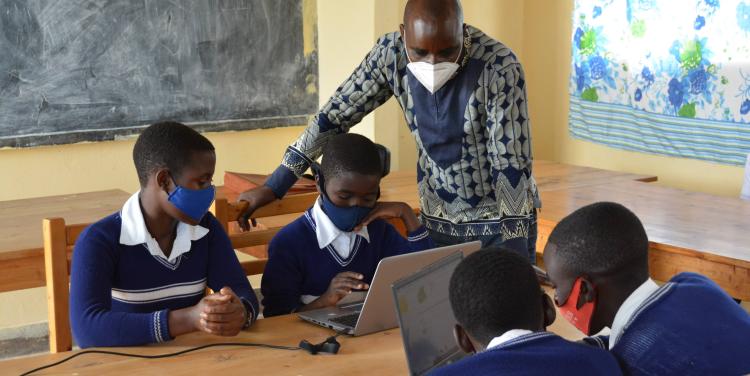
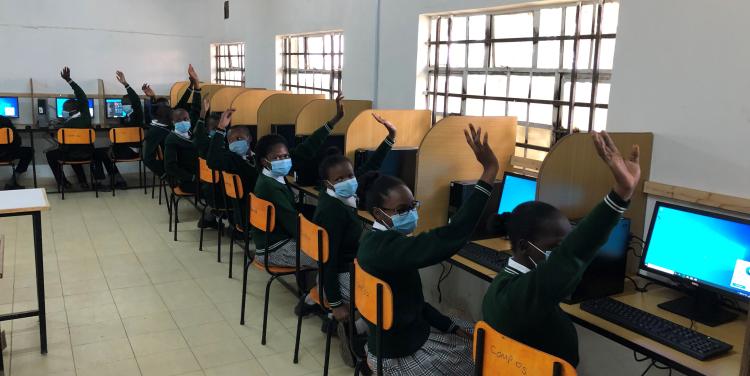
up to 6000 hours of training in a developing country. This means basic
computer literacy for at least 48 children from just one donated computer. How does the WEEE directive affect charities
such as Computer Aid International? "The government believes that the inclusion of re-use of whole appliances in evidence returns delivers the most appropriate and strongest incentive...to work with genuine re-use organisations and to prioritise re-use of whole appliances where appropriate." The government is also encouraging re-use charities to register as an AATF to enable them to continue their vital work.
Do I need to worry about data security? British Airways, Ford, Virgin Travelstore, Honda Formula 1, the National Audit Office, Royal Mint, Packard Bell and Christian Aid. For more details on companies that have used Computer Aid's decommissioning services, click here.
Computer Aid International has been approved by the environment agency to operate as an Authorised Approved Treatment Facility (AATF) for Waste Electrical and Electronic Equipment (WEEE).Having AATF status means that Computer Aid International is now authorized to issue the evidence notes required by Producer Compliance Schemes (PCSs), which are designed to prove that original IT equipment manufacturers have paid for the recycling of their products and are therefore complying with the law. Any equipment that Computer Aid is unable to re-use that doesn't pass our stringent quality tests, is recycled through licensed waste management companies that guarantee 0% of unusable equipment ends up in landfill. To improve our services further we are currently working towards the Quality Management Standard ISO 9001:2000 and Environment Management standard ISO 14001.
Who is responsible for enforcing the WEEE directive? The Environment Agency (SEPA in Scotland and EHS in NI)
are the enforcement agency for the WEEE Directive. The DTI is responsible
for transposing the WEEE Directive into UK law, working in partnership
with the Devolved Administrations.
Why it is better to donate your IT equipment to Computer Aid International rather than send it to a Producer Compliance Scheme? Donating your unwanted IT equipment to Computer Aid is both environmentally friendly and socially responsible. You will be fully complying with the WEEE directive and benefiting from our professional free PC decommissioning service. Schools and universities in the developing world using a PC professionally refurbished by Computer Aid will enjoy at least 3 or 4 years productive PC use. This effectively doubles the life of a PC halving its environmental footprint whilst enabling some of the poorest and most marginalised people in the world to have access to computers. For more information about Computer Aid International’s decommissioning services please contact Anja ffrench on 020 8361 5540, email anja@computeraid.org, or visit the PC donation section of our website. |
|
|
|
|
|
||||
Check
our bone fides as a registered charity; not-for-profit company, and
international NGO with these public databases
Bond Member (British Overseas NGOs for Development) Reg Charity No 1069256 Reg Company No. 3442679 |
||||
Read
our privacy policy |
||||
©
Computer Aid International |
||||